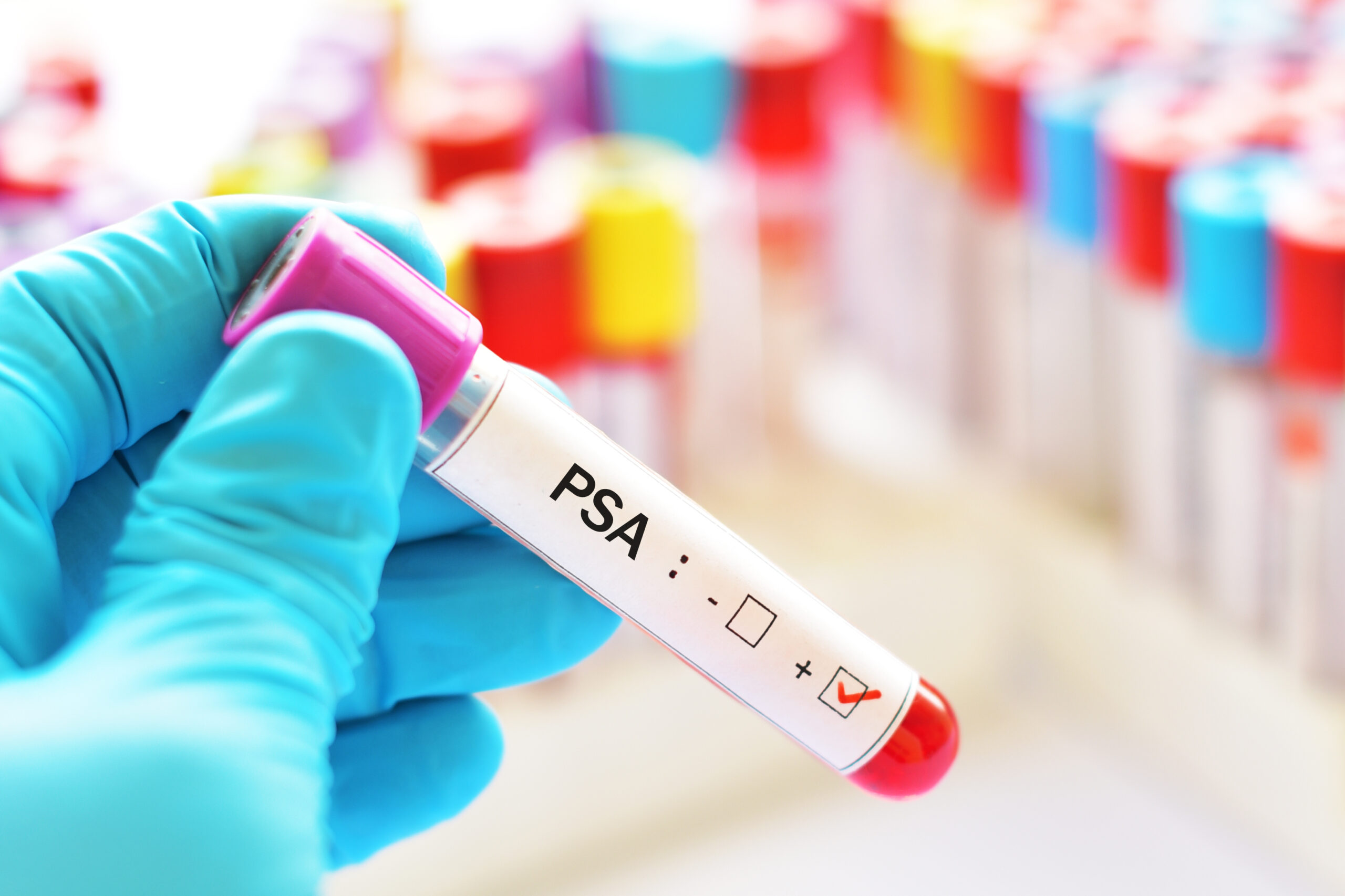

What is a PSA Test? Understanding Prostate-Specific Antigen
Watch: What is a PSA Test?
In this brief overview, Dr. Daniel Spratt explains the basics of the PSA protein and the PSA test.
What Does PSA Mean?
PSA stands for Prostate Specific Antigen, a protein enzyme produced by the prostate and found mostly in the semen, with very small amounts released into the bloodstream. A PSA blood test measures the concentration of this protein in your blood, typically measured in nanograms per milliliter (ng/mL). It is used as a “disease marker” to screen for prostate cancer and to monitor how the cancer is responding to treatment. When there’s a problem with the prostate, such as the development and growth of prostate cancer, more PSA can be released. PSA eventually reaches a level where it can be easily detected in the blood. This can be the first indicator of prostate cancer.
How the PSA Test is Performed
PSA testing is the current leading method of prostate cancer screening. During a PSA test, a small amount of blood is drawn from a vein (usually in the arm) by a healthcare professional. The procedure is quick, relatively painless, and typically takes less than five minutes. The blood sample is then sent to a laboratory for analysis to measure the total PSA, which includes both “free” and “protein-bound” forms of the antigen. A PSA test may be performed alongside a digital rectal exam (DRE), where a physician inserts a gloved, lubricated finger into the rectum to check the prostate for physical irregularities in size or texture. While the PSA test is more sensitive, the two tests together provide a more complete picture of your prostate health.
Why Do Doctors Recommend PSA Screening?
Early prostate cancer almost never causes symptoms. Doctors recommend PSA screening to detect aggressive, higher-risk cancers early when they are small and more likely to be cured. Early detection may also lead to treatment with fewer side effects compared to treating advanced disease. However, the decision to get screened should be a shared decision between you and your doctor. Medical organizations now emphasize “shared decision-making” because the test isn’t perfect, it can sometimes lead to over diagnosis or unnecessary biopsies. Current guidelines recommend starting these discussions at age 45, or as early as age 40 if you are at higher risk (such as African American men or men with a strong family history of prostate or other cancers).
How to Prepare for a PSA Blood Test

To ensure the most accurate results, it is important to follow specific preparation guidelines. Certain factors can cause a temporary increase in your levels, leading to a “false positive.” For at least 48 hours before your PSA blood work, you should avoid:
- Prostate Stimulation: This includes ejaculation.
- Vigorous Exercise: Intense physical activity can temporarily raise PSA.
- Medications: Some drugs, like finasteride (Proscar® or Propecia®) or dutasteride (Avodart®), can lower your PSA. Always inform your doctor of any medications and supplements you are taking.
- Avoid medical procedures involving the urethra or bladder (such as catheterization), as these can irritate the prostate and temporarily increase PSA levels.
Understanding Your PSA Test Results: Normal vs. High
Interpreting PSA test results is more complex than a single “pass or fail” number. Historically, a PSA level of 3 or 4 ng/mL was considered the universal “cutoff” for a normal result. However, we now know that PSA levels naturally rise with age as the prostate grows, and many physicians now use age-adjusted PSA ranges to determine if a result is concerning:
- Age 40–49: Levels above 2.5 ng/mL may be considered elevated.
- Age 50–59: Levels above 3.5 ng/mL often warrant closer monitoring.
- Age 60–69: Levels above 4.5 ng/mL are typically used as a threshold.
- Age 70+: Levels above 6.5 ng/mL generally require further investigation.
Your doctor will not look at a single PSA test result by itself. They will look at your PSA level over time, comparing it with your prior test results to measure how fast the number is rising.
Your doctor will also consider whether there could be a benign (non-cancerous) explanation for a high PSA. Common causes include prostate inflammation (prostatitis), benign prostate enlargement (BPH), a larger prostate size, or a urinary tract infection or irritation.
It is important to remember that a high result is a starting point for a conversation with your doctor, not a prostate cancer diagnosis. For a deeper look at your specific numbers and what factors influence them, explore our full resource on interpreting PSA levels. You can also learn more about other causes of a high PSA to understand why your levels might be high.


What Happens After a High PSA Result?
It is important to highlight that a PSA test is a screening test, not a diagnostic test. A high result alerts you and your physician that more testing may be needed to determine if a prostate biopsy is necessary. Based on your specific PSA levels and history, your doctor may recommend several follow-up steps:
Repeat Testing
If PSA is only slightly elevated, your doctor may recommend repeating the test a couple of weeks later to see if the level stabilizes before taking further action.
PSA Density
This measures the amount of PSA per volume of the prostate (determined by imaging). A higher density typically indicates a greater risk of cancer.
Reflex Blood Markers
Specialized tests such as the Prostate Health Index (phi) or the 4Kscore can help predict the likelihood of finding aggressive cancer.
Urinary Markers
Advanced urine tests, including the EPI test (where a score >15.6 indicates higher risk), PCA3, or SelectMDx.
Imaging
A Multiparametric MRI of the prostate can help identify specific suspicious areas.
Depending on the results of these tests, your doctor may recommend a prostate biopsy. A prostate biopsy is the only way to confirm the presence or absence of prostate cancer. For a detailed roadmap of what happens next, see our video on What is next after a high PSA result?
PSA Monitoring and Recurrence
PSA testing also is used after prostate cancer treatment to monitor for disease recurrence and assess how the cancer is responding. Monitoring depends on your specific treatment; explore our resources for PSA after surgery and PSA after radiation therapy to understand more about your post-treatment numbers. For all patients treated for localized prostate cancer, we also offer a comprehensive overview on PSA monitoring after initial treatment.
Frequently Asked Questions (FAQ)
A PSA test is a blood test that measures the level of Prostate-Specific Antigen, a protein produced by both normal and cancerous cells of the prostate. Very small amounts pass from the prostate into the blood. The PSA blood test is measured in units per milliliter of blood (ng/mL).
While PSA is sometimes called a “tumor marker,” it is actually a marker of prostate activity. A PSA level can be elevated due to prostate cancer, but also due to non-cancer conditions like an enlarged prostate (BPH) or an infection (prostatitis).
Anyone who has a prostate gland can potentially develop prostate cancer. All men should be screened regularly with a PSA blood test. When caught early, the cure rate is 99%.
We recommend regular PSA tests for all men starting by age 45, or by age 40 if you have prostate cancer risk factors, including being a Black man or having a family history of prostate, breast, ovarian, pancreatic, or colon cancer. Also start by 40 if you or a family member have tested positive for potentially harmful gene changes (mutations) such as BRCA and ATM.
Avoid ejaculation and vigorous exercise (especially cycling) for at least 48 hours before your PSA test. These activities stimulate your prostate and can temporarily increase your PSA level. For the same reason, you should wait several weeks after completing treatment for a urinary tract infection (UTI) or having a prostate biopsy to have a PSA test.
In addition to avoiding prostate stimulation for at least 48 hours before your PSA test, make sure your doctor knows your family cancer history and inform them if you are taking medications like finasteride or dutasteride, which can artificially lower PSA levels.
The PSA test is the leading method for prostate cancer screening, but it is not perfect. Its primary benefit is detecting aggressive, high-risk cancers early when they are most treatable, potentially reducing the risk of death. However, it can also lead to overdiagnosis or false positives, which is why it is best used as one tool in a larger diagnostic “toolkit”.
Total PSA measures all the PSA in your blood, while Free PSA measures the portion not bound to certain blood proteins. If your total PSA is in the “gray zone” (between 4 and 10 ng/mL), doctors use the percentage of free PSA to help estimate the risk of cancer; a lower percentage of free PSA generally indicates a higher likelihood that cancer is present. <10% Free PSA indicates greater risk, while 10-20% is considered borderline.